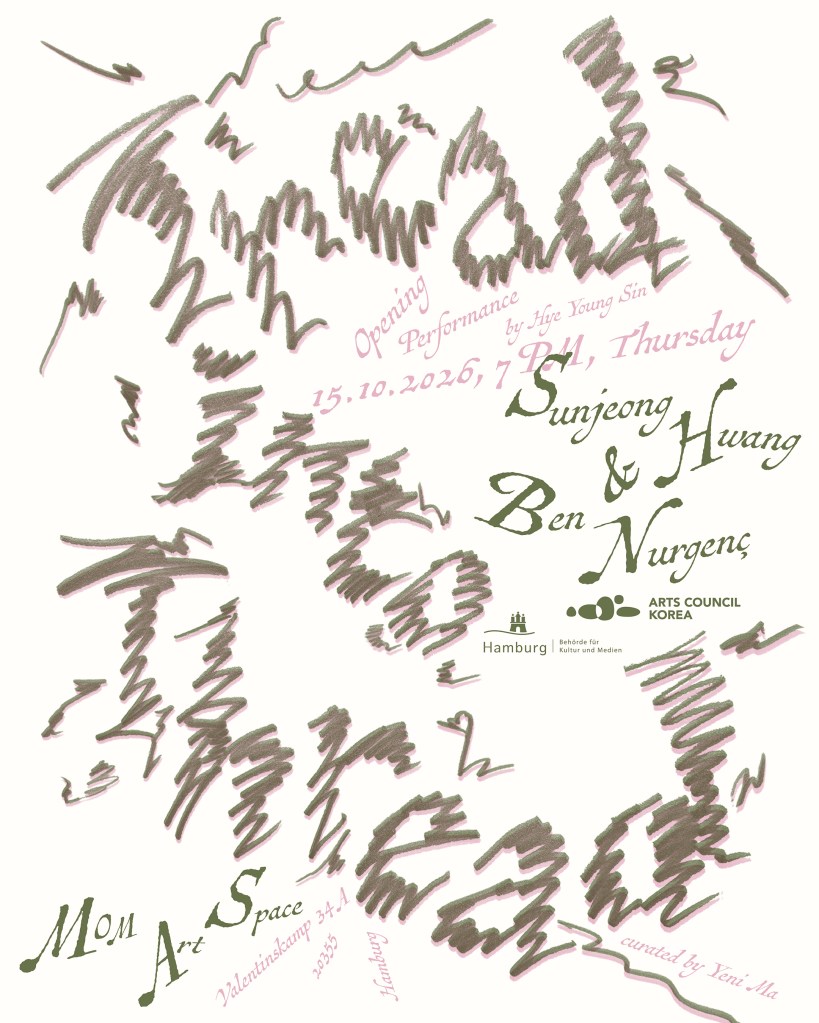
Artists
Sunjeong Hwang, Ben Nurgenç
Curator
Yeni Ma
Opening Performance
15. 10. Thu, 19:00
trashes, Hye Young Sin
Exhibition Dates
14.–18.10. Wed–Sun, 15:00–19:00
Venue
MOM Art Space, Valentinskamp 34A, 20355 Hamburg
Supported by
Arts Council Korea
Behörde für Kultur und Medien Hamburg
Ben Nurgenç
Ben Nurgenç is a concept-based artist and mycologist. His artistic practice is research-based and operates at the intersection of art, ecology, and field research. His current work centers on the artistic contextualization of biotope explorations, hikes, and scouting processes as performative practices. Building on scientific fieldwork in habitat mapping, he explores movement, observation, and mapping as artistic practices.
Sunjeong Hwang
Sunjeong Hwang is a transmedia artist exploring posthuman thought, generative technologies, and ecological systems. Working across AI, generative coding, moving image, sound, and movement, she creates multisensory environments where biological and computational temporalities coexist and reshape one another. She recently held a solo exhibition at the National Museum of Kazakhstan (2026) and participated in the 16th Curitiba International Biennial (2026), following a residency at transmediale, Berlin (2025).
Programme
Forest Walk with Ben Nurgenç
Thu, 08.10., 11:00–18:00
Forstgutsbezirk Sachsenwald
A guided forest wayfaring with artist-mycologist Ben Nurgenç, attending to old trees, fungi, and other traces of the forest’s living networks.
Opening Performance
trashes by Hye Young Sin
Thu, 15.10., 19:00
Hye Young Sin is a Berlin-based artist working through DIY electronics and sonic experimentation. In this performance, discarded objects from her kitchen and studio are fitted with small motors and set into contact with one another; sound arises not from any single object, but from their collisions and the connections that break and reform between them, unfolding through relations no one party fully directs.
Preface
Tread into Thread
Every day, people move from home to work, from home to school, from somewhere to somewhere else. Having chosen the fastest and most efficient route, they walk without ever noticing what walking is, rushing forward, half-conscious of their own steps. Feet touch the ground, but they leave no trace; they are simply spent on the way to a single destination. This exhibition, bringing together Ben Nurgenç and Sunjeong Hwang, seeks to open a small crack in this destination-driven movement, like a subway suddenly cancelled, or a bus that unexpectedly changes its route.
The title Tread into Thread points toward the direction this crack opens onto. A tread, in its original sense, is a trace left at a single point: a mark stamped where a step has passed. But in this exhibition, the tread, having lost its sense of purpose, no longer settles into a fixed point. Instead, it aspires to connect, to become a line, to become a thread. Unlike a trace, a thread can be wound, woven, and hung from; it exists in a state of becoming, being woven or unravelled. This exhibition, too, is less a finished outcome than an exhibition in its exhibiting: not a noun settled into its shape, but a verb still unfolding, tying its own knot as it goes.[1]
Ben Nurgenç’s performative forest walks cut across the fictional lines drawn on maps: lines of latitude and longitude, borders dividing one zone from another. His movements, recorded by GPS, may at first resemble the familiar boundary lines we know from maps. But these lines were never predetermined; they are drawn through negotiation with everything encountered along the way. In a forest with no path, he crosses small streams, follows old trees, and pauses, wrapping a rope around a trunk to measure its girth, guessing its age, bending down to look at the mushrooms nearby. This act of measuring is not really about obtaining a number. It is closer to a gesture of standing, however briefly, alongside the slower time in which the tree has lived. In the exhibition space, the records participants left in their own ways, along with what they sensed while walking, accumulate and are laid out for visitors to sense anew. The rope that measured a tree’s girth, fragments of wood or mushroom and other forest matter he collected, and photographs of landscapes encountered by chance are laid over a GPS line drawing, inviting visitors to follow a line made not by an acting subject, but by one who responds.
Sunjeong Hwang asks, through sound and video installation, whether embodied human sensation can be translated into data, and under what conditions it might be remembered. For the artist, memory is not fixed to a single point in the past but exists as a living state, layered and entangled. Images and sounds gathered together with other participants in Nurgenç’s walking workshop become, as a sensory experience and a memory, the raw data of Hwang’s sound work. Yet this data does not take shape according to the artist’s intention; instead, it continues to shift, minutely, under the conditions of the exhibition space itself. The artist likens this process to fermentation: like fermentation, this sound exists without a fixed outcome or a goal to be reached, remaining instead in a constant state of transformation, shaped only by an environment and its relations that themselves keep changing over time. But not every sensation can be translated this way. Certain gestures, certain relations, the particular air of a certain moment, remain ungrasped by sound, by image, by any form of data, and are simply left behind, in place. Because for the artist, human experience is never fixed but continually transformed through body, relation, and environment, this work is also a question about the boundary itself: what becomes data, and what does not.
Through these two projects, what the exhibition proposes is not a destination but something closer to a knot: footprints that, in the process of becoming, form a line, and lines that entangle with one another into something tied together. To refuse the fast route, as Nurgenç does, and to dwell deliberately in an unresolved state, as Hwang does, may not offer immediate satisfaction. But the knot made this way allows things to entangle with what surrounds them, longer, and more firmly, opening onto a world without discrete objects. „What is important is not the final destination, but all the interesting things that occur along the way,“ and the entanglement with them. May this exhibition become a detour on the path you walk every day.
[1] Tim Ingold proposes thinking things not as nouns but as verbs, in motion: not „the tree“ but „to tree,“ not „the stone“ but „to stone.“ Every thing is, rather than has, the story of its own differentiation. Tim Ingold, Correspondences, p. 7.

