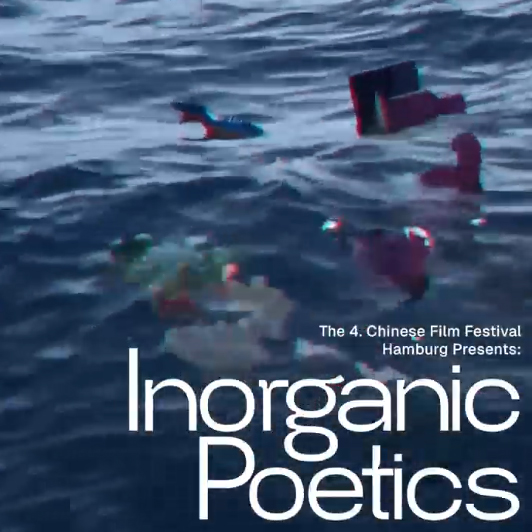
The 4. Chinese Film Festival Hamburg presents
Inorganic Poetics
Preface
Technics, mythologies, landscapes, or protocols—these heterogeneous vectors do not unfold as parallel historical trajectories. Instead, they interweave and entangle within a singular field of reality, functioning as mutual kinetic forces. Following Bruno Latour’s Actor-Network Theory, agency is no longer the exclusive domain of the human subject. Infrastructure, mineral strata, urban hydrospheres, technological acoustics, and mythic imaginaries, among other divergent formations, constitute an assemblage of seemingly silent non-human agents that exert active force within relational networks. Far from being neutral backdrops or inert containers, they are vital participants in the restless processes of linkage, differentiation, and feedback through which reality itself is folded.
The works gathered in this exhibition intervene precisely within this relational tension. Through the drone-eye gaze upon infrastructural ruins, trans-geopolitical sensory dislocations, the archival tracing of terrestrial and aquatic flux, and corporeal interventions within familial memory and industrial soundscapes, human agency and non-human forces are woven into a structure that resists stabilization. What we propose as „Inorganic Poetics“ does not invoke a romanticized naturalism; rather, it seeks a mode of attunement to the „process of emergence.“
In this context, the object-landscape functions as an interface for circulating forces, memory and power sediment into one another, and history remains in a state of continuous revision through its friction with the contemporary. „Inorganic Poetics“ is not a conclusion, but a posture held in tension with the present. It invites the viewer to linger within the interstices where latent forces intersect with human action—within a yet-to-be-fully-named middle ground, to recalibrate our perception of the very conditions under which the present takes form.
Text by Zhichao Zhu
Schedule of Events
Exhibition Dates: 06 – 10 May 2026
Venue: MOM ART SPACE (Valentinskamp 34A)
Opening Reception: 05 May, 19:00
Opening Hours: 14:00-20:00
Live Cinema Performance:
08 May, 18:00, BLUE SUN (25–30 min)
Curator: Zhichao Zhu
Curatorial Team: Zhiwen Ding, Yao Su
Participating Artists
Qian Han / Yujue Liang / Rhett Tsai / Mia Yu / Yen Wang
Yun / Wuji Ye / Tianming Zhou
Academic Support
Dagmar Rauwald, Dr. Stefanie Thiedig
Panel Talk: Art talk with Dr. Stefanie Thiedig, Dagmar Rauwald, Mia Yu, Qian Han, Zhichao Zhu and Online guests via zoom
Date: 05 May, 15:00 – 17:30
Venue: Seminarraum, Valentinskamp 34A
Free entrance
Invited by Dagmar Rauwald
Gefördert von der BKM Hamburg
Something Misplaced
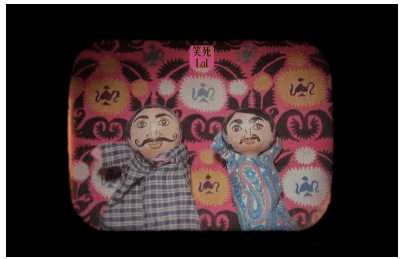
Ye Wuji
Single-channel video, color, sound, 37 mins, 2023
Most of the footage was shot in Kazakhstan and Uzbekistan. The film is a non-linear or
esentation of what the artist saw and thought during his journey. The work explores the complexity of „Central Asia“ and the confusion it brings. Weaving and connecting through random footage shot during travelling (landscapes & cityscapes, process of conversations, etc.) with the books, images, music, and personal experiences that the artist has been collecting over the last few years, the film links the materials to each other while interrupting the narrative. Something Misplaced intends to capture a pervasive and challenging sense of misplacedness and weaves it through the traces of similarities and differences between “China” and „Central Asia”.
Ye Wuji was born in China Proper in 1991, the year the Gulf War broke out, the construction of the Taklamakan Desert Highway began, the world’s first website was created, Saudi Arabia screened its first movie, and the KGB ceased all operations. On a Sunday in 2019, Ye Wuji became a member of the Central Asian Plov Society and firmly believed that plov is the most delicious food in the world. From 2015 to 2024, a major part of his practice has focused on the
Tianshan Mountains regions and the Eurasia connects to it. Recently, he has also become a dutar apprentice. Today, Ye Wuji is one among 8 billion people.
《甘棠,湖》(Gan Tang, The Lake)
周天鸣
单频影像,彩色,有声,14分钟,2024
2023年夏天,九江市政府启动了甘棠湖清淤工程。数周内,这座拥有两千多年历史的湖泊被抽干了湖水。在附近的甘棠公园里,一个男孩在雨中醒来。
周天鸣,独立影像创作者。本科毕业于香港大学,后获杜克大学MFA学位。曾获北卡罗来纳州艺术理事会基金与Interbay Cinema Society Lightpress创作资金资助。他的作品多探索现实景观或概念景观的“里”、“外”与“之间”,常融合多种媒介与蒙太奇手法,以模糊地域、文化及存在方式的边界。作品曾入围武汉柏林,北京短片联展,Antimatter, Interfilm, Mimesis Documentary Festival, Experiments in Cinema, Non-Syntax, Leiden Shorts等国际影展。
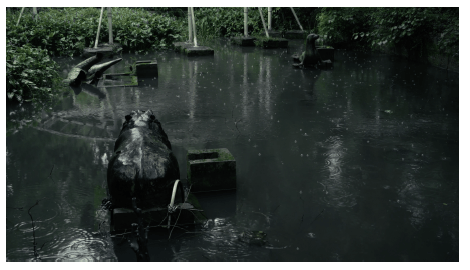
Gan Tang, The Lake
Tianming Zhou
Single-channel video, color, sound, 14 mins, 2024
In the summer of 2023, the government of Jiujiang launched the Gan Tang Lake Cleansing Project. Within weeks, this ancient lake with over two millennia of history was drained. Nearby in Gan Tang Park, a boy wakes up in the rain. There, the destiny of Gan Tang awaits.
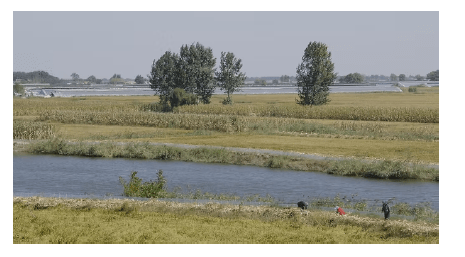
《一日距离》(One Day Distance)
韩倩
影像装置,4K高清单频录像,彩色立体声,34分01秒,2024
在这件作品中,艺术家穿着祖母在世时从未穿过的一双高跟鞋和最常穿的裙子从后杨家走到牛庄。这段二十八公里的路程从早上六点的清晨日出出发,结束在傍晚六点的落日余晖中。
这一日的距离也是艺术家祖母30年代的出生地到她素未谋面即将嫁入的丈夫家的距离。在她踏上这段路程时,还未对一千多公里之外的中原有所想象,也无法得知在此后她将和家人散落或停留在各地不同的命运。
韩倩的创作结合了录像、装置、行为、版画等多种媒介。长期以来,她关注着时间、记忆以及黏附着这两者的物与历史痕迹。她的工作常从个人家庭与工业迁移的微观线索出发,追索数代人在剧变地景中的迁徙与定居,并由此重新感知身份政治与地缘认同。
在此过程中,她将这种对个体经验的关怀延伸至更广阔的生命维度。透过对隐藏线索与脆弱材料的梳理,借由对物之残余、身体动作与空间关系的重组,她尝试使那些被忽略的断裂重新显形。
One Day Distance
Han Qian
Video installation, Single channel 4k video, color, stereo channel, 34’01’’, 2024
In this work, the artist walks from the Houyang family to Niuzhuang, wearing a pair of high heels her grandmother never wore and her most commonly worn dress. This twenty-eight-kilometer journey begins at sunrise at six in the morning and ends at sunset at six in the evening.
This distance traveled is also the distance from the artist’s grandmother’s birthplace in the 1930s to her future husband’s home, whom she has never met. As she embarks on this journey, she has no imagination of the Central Plains of China over a thousand kilometers away, nor does she realize the different fates her family will face, scattered or lingering in various places.
Han Qian’s practice spans video, installation, performance, and printmaking. Over the years, she has been concerned with time, memory, and the material traces and historical residues that adhere to them. Beginning with micro-histories drawn from family narratives and industrial migration, her work traces the movements and settlements of several generations within rapidly shifting landscapes, re-examining questions of identity politics and geopolitical belonging.
In this process, her attention to individual experience extends toward broader forms of life. Through the reconfiguration of hidden clues and fragile materials, and by reorganizing residual objects, bodily gestures, and spatial relations, she attempts to bring overlooked ruptures back into visibility.
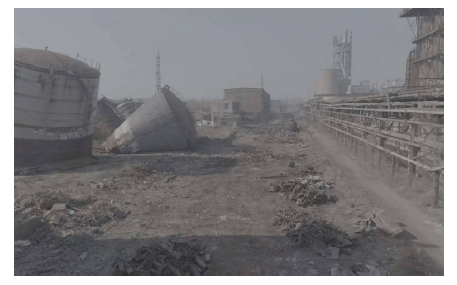
《额姆宇宙》(Eme Cosmos)
于渺
单频影像,彩色,立体声,23分钟,2024
拍摄于亚洲最大的露天矿场,影片讲述了一个困扰中国东北化石燃料开采地景的神话故事。通过将神话与纪录片结合,影片释放了对受损土地的疗愈力量,将“能量”构想为一种关怀与共鸣的伦理,而非单纯被榨取的物质实体。 于渺是⼀位策展⼈、研究者和影像创作者。她关注采掘地景、能源基础设施(煤炭、⽯油、⽔电)和⽣态政治之间的复杂互动。于渺的创作基于在地⾛访和历史研究,将图像、神话传说、宇宙观、诗歌和表演编织为思辨叙事。她的“抚顺三部曲”,包括《额姆宇宙》、《琥珀》,《给你讲⼀个关于沉积的未来故事》,曾在歌德学院、时代美术馆、中央美术学院美术馆、汉堡美术馆展出。于渺策划的展览围绕⽣态议题展开,包括“化⽯阳光,沉积之⾝”、“地缘与地质之间”、“微光渐暗”、“2021年 OCAT双年展:百物之息单元”、“从符拉迪沃斯托克到西双版纳”等。于渺曾在哈佛⼤学、伦敦⼤学、康奈尔⼤学、多伦多⼤学、北京⼤学、考陶尔德艺术学院、⾦匠学院等院校分享过她的研究,也曾在中国美院 IMFA教授研究⽣课程。她的学术⽂章发表于ARTMargin,Afterall, Artforum, Art Review Oxford, LEAP, Art Monthly等刊物。她的影像作品被西雅图美术馆和华盛顿州⽴⼤学图书馆收藏。
Eme Cosmos
Mia Yu
Single-channel video, color, stereo sound, 23 mins, 2024
Shot on Asia’s largest open-pit mine, Mia Yu’s film “Eme Cosmos” (2024) tells a mythic tale that haunts the landscape of fossil fuel extraction in Manchuria (Northeast China). By integrating mythology with documentary, the film unleashes the therapeutic power to the disturbed land while envisioning “energy” as an ethics of care and resonance rather than a material entity to exploit.
Mia Yu is an artist, art historian, and independent curator working between Paris and Beijing. Her practice is built on long-term field research at large-scale infrastructures and extractive sites, and examines the complex relationships between post-extractive nature, cosmology, and
geopolitics in the Asian context. Her works have been exhibited and screened at the Centre Pompidou, Palais des Beaux-Arts de Paris, Photografiska, the Goethe-Institut, Kunstmuseum Wolfsburg, Times Museum, Kunstverein Hamburg, Harvard University, and Serendipity Arts Festival. Her writings have appeared in Artforum, Oxford Art Review, Art Monthly, and the Afterall Exhibition Histories book series. Mia Yu has taught at the China Art Academy and is currently a visiting researcher at the École normale supérieure in Paris.
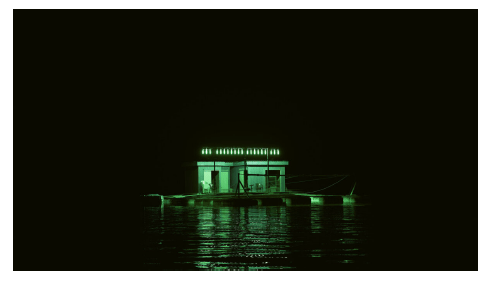
《失钓》(Luring Bad)
蔡宇潇
CGI 影像,彩色,有声,18分钟,2026
《失钓》是一部实验性的 CGI 短片,设定在由人工捕鱼灯制造的绿色梦境之中。渔夫在水面上沉睡,而水下的鱿鱼群则被引诱进入一种紧张的状态。作品通过游戏引擎与数字模拟重构渔场空间,将“做梦者”与“被梦见者”、“引诱者”与“被引诱者”相互缠绕。借由鼾声、绿光以及多重文化指涉,影片反思权力、捕捞/攫取机制,以及当代亚洲尚未解决的结构性状态。
蔡宇潇(b. 1995)是一位中国艺术家,专注于沉浸式技术、影像、实验性视频游戏的叙事实践。蔡宇潇的实践带有强烈的亚洲问题意识,直面由当今的技术革命、媒介社会以及文化身份构建的话语和权力,他常用当代数字工具构建替代性历史,探讨多重历史叙事下的异乡感、含糊身份以及个体困境。他是2023年流明奖“華艺数奖”的获得者。他的作品曾在林茨电子艺术节(奥地利)、威尼斯军械库(意大利)、中国美术馆(中国)、Watershed Art & Ecology(美国)、Sónar 电子艺术节(西班牙)等平台展出。他任教于中国美术学院。
Luring Bad
Rhett Tsai
CGI short film, color, sound, 18 mins, 2026
Luring Bad is an experimental CGI short film set in a green-lit dreamscape generated by artificial fishing lamps. A fisherman sleeps on the water’s surface while shoals of squid are drawn into tension below. Reconstructed through game engines and digital simulation, the film entwines dreaming and being dreamed, luring and being lured. Through snoring, green light, and layered cultural references, the work reflects on power, extraction, and the unresolved conditions of contemporary Asia.
Rhett Tsai is a Chinese artist focusing on immersive technologies, video, and experimental video game narrative practices. His work carries a strong awareness of contemporary Asian issues, directly confronting the discourses and power structures shaped by today’s technological revolution, media society, and constructions of cultural identity. He is the winner of the 2023 Lumen Prize “HUA Award.” His works have appeared at Ars Electronica Festival, the Venetian Arsenal, the National Art Museum of China, Watershed Art & Ecology, Sónar Festival, and more. He teaches at the China Academy of Art.
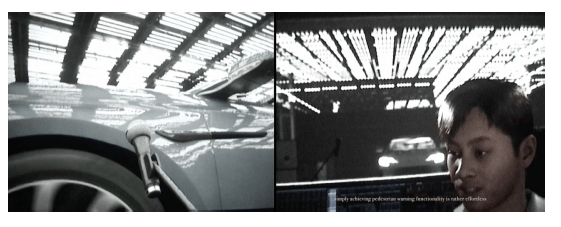
《能量在一到两秒之内循环》(The Power Circulates in One to Two Seconds)
梁宇珏
双屏影像,彩色,有声,4分钟,2025
记录了上汽集团声学工程师王正己叙述为新能源汽车创造 AVAS(行人警示音)的过程。作品采用伪纪录片手法,探讨工程师如何利用声音传达电车的速度与力量,并塑造未来城市景观。在对现实的模拟中,真实逐渐迷失,走向熵增的消解。
梁宇珏(b. 1991,安徽)现生活和工作于上海。
梁宇珏的实践意在探索技术、能源、声音和认知之间的关系,通过挖掘声
音与声音背后的文化含义,探讨人与技术、媒介之间的关系。
梁宇珏的创作涉及科技、生物、环境、记忆和认知的历史演变,他倾向于
运用听觉和感知的方式引入空间体验、装置、影像、图像和社会人类学,
并通过与不同背景和领域的观众和创作者的沟通展现一种更具交互性和联
结性的叙事。
The Power Circulates in One to Two Seconds
Yujue Liang
2-channel video, color, sound, 4 mins, 2025
The video series documents Wang Zhengji, the sound engineer at SAIC. Motor, as he narrates the process of creating AVAS for new energy vehicles in an acoustic studio. It also explores how sound engineers like him utilize AVAS to convey the speed and power of electric vehicles, while envisioning and shaping the future urban landscape. Through the use of an old DV tape camcorder and CRT television, the work adopts a mockumentary approach to present a virtual representation of the sound engineer. The hyperrealism simulated by the game engine parallels how sound engineers employ AVAS to mimic the noise of traditional combustion engines. In this simulation of reality, the real becomes lost, inevitably sliding toward an entropic dissolution of itself
Liang Yujue’s practice explores interactions between technology, energy, sound and cognition, and examines the relationship between people, technology and media through the excavation of sound and the cultural significance behind it. His oeuvres involve the historical evolution of technology, biology, environment, memory and consciousness. He tends to introduce spatial experiences, installations, videos, images and socio-anthropology using aural and kinesthetic methods, and to present a more communicative and inter-connective narrative by engaging with viewers and creators from diverse backgrounds.
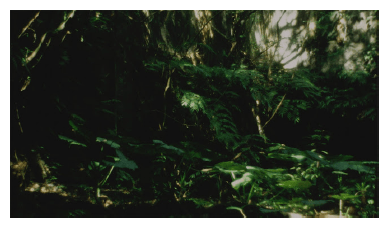
《蓝太阳》(Blue Sun)
閻望雲 | 现场电影表演,彩色,有声,30分钟,2025
配乐与音效设计:蔡秉儒 | 现场绘画:金孟萱
在台湾作家童伟格的小说中,叙述者在一系列奇诡的感知中描述了“蓝色的太阳”。这颗蓝太阳高悬在1980年代中期夺走无数生命的矿难矿山上。延续这一文学隐喻,《蓝太阳》着手记录台北北部后矿区和灾后村落。通过短片与表演,该项目试图将地景中残留的能量从文学转化为
其他艺术媒介。其影像剧场交织了即兴电影投影、声音和现场木炭绘画。在现场形式中,《蓝太阳》是一个多变且累积的过程,每一次迭代都产生新的绘画并提出不同的声画连接,皆指向记忆的不稳定性。
閻望雲是一位生活在台北与阿姆斯特丹的作家和艺术家/电影制片人。他的工作涉及纪录片、胶片技术和表演,关注语言和画面如何在个人与集体层面中介我们对世界的体验。他是鹿特丹艺术家自营电影实验室 Filmwerkplaats 的成员,也是阿姆斯特丹文化分析学院 (ASCA) 的博士研究员。
Blue Sun
Yen Wang-Yun
Live cinema performance, color, sound, 30 mins, 2025
Soundtrack & sound design: Nick Tsai
Live drawing: Chin Meng-Hsuan
In Taiwanese novelist Tong Wei-Ger’s short story, the narrator describes the blue sun amid a series of strange perception. The blue sun hangs high in the mountain where the mining incidents took numerous lives in the mid-1980s. Following the literary metaphor, Blue Sun sets out to document the post-mining and post-disastrous villages in Northern Taipei. With short film and performance, the project attempts to translate the lingering energy in the landscape from literature to other artistic mediums. The image theatre of Blue Sun weaves together improvised film projection, sound, and live charcoal drawing. In its live form, Blue Sun is a variable and accumulative process. Each iteration produces a new drawing and proposes a different sound-image conjunction, all pointing to the instability of remembrance.
Yen Wang-Yun is a writer and artist/filmmaker based in Taipei & Amsterdam. He works with documentary, analogue film technique, and performance. He is interested in how languages and pictures mediate the experience of the world, from the personal level to the collective. He is a member of the artist-run film lab Filmwerkplaats, Rotterdam, and a PhD researcher at the Amsterdam School for Cultural Analysis (ASCA).
Invited by Dagmar Rauwald
Gefördert von der BKM Hamburg